
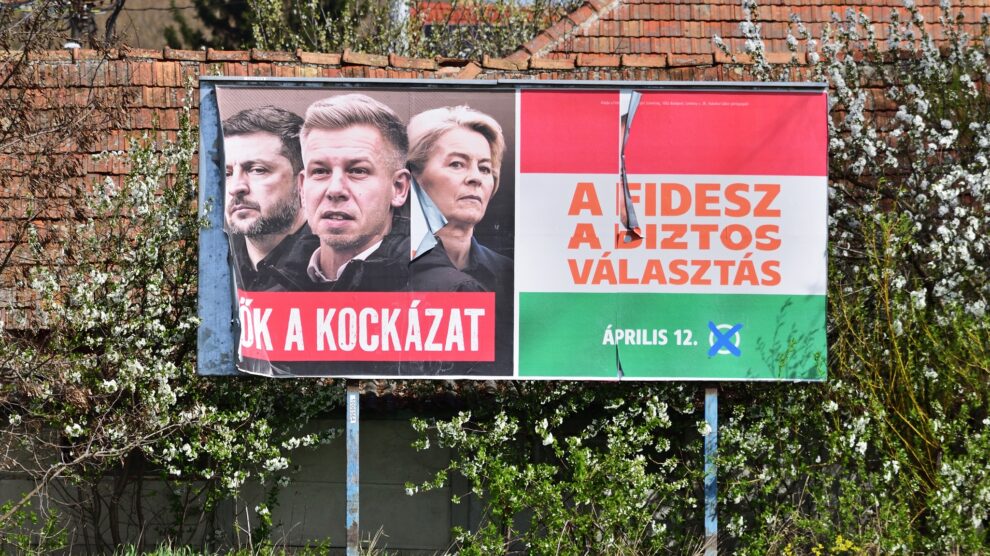
Hungary’s election result is a gift for investors, if the new government can deliver the swift reform that the European Union wants to see.
In the end, it wasn’t even close. After sixteen years in office, Viktor Orbán’s Fidesz party was trounced in a parliamentary election in Hungary on April 12, winning just 55 seats in the country’s 199-member parliament. Tisza, the party led by Péter Magyar, a former Fidesz insider, will have at least 138 seats in parliament, enough to form a ‘supermajority’ that would enable it to change the constitution, rolling back the system of so-called state capture put in place by Orbán during his time in office.
Likely to be first on Magyar’s to-do list will be repairing Hungary’s relationship with the European Union, not least the unlocking of 17 billion euros in funds, blocked for many years over Hungary’s democratic backsliding. Not that doing so will be easy. Tisza will need to come up with a revised Recovery and Reconstruction Plan (RRP) by August, necessary to secure the 10 billion euros allocated to Hungary as part of the EU’s post-Covid recovery funding. If the money is not unfrozen by August 31, it will be lost for good. Issues around the country’s procurement rules, judicial independence, and academic freedom must be dealt with before any money will be forthcoming. The supermajority should allow Tisza to push through the reforms Brussels needs, but it will need to get to work on doing so promptly.
The remaining seven billion euros in frozen funds are linked to separate EU payouts made to poorer regions, which are governed by different rules. Magyar will have more time to claim those funds as they expire after 2028.
Investors in Hungary (both actual and potential) will be buoyed by Tisza’s victory and the prospect of a period of renewal in a country which has seen living standards fall and purchasing power reduced in recent years. It was this fall in living standards, and rises in the cost of living, that were the key factors in Orbán’s downfall, rather than concerns over democratic backsliding. Hungary remains a conservative country, and Magyar, though he has been cagey about his stance on social issues, does not appear to be much of a liberal.
What’s clear, however, is that Hungary is likely to move away from Orbán’s policies of crony capitalism that worked well for his inner circle but did little for businesses across the country. Investors will also be pleased that Orbán, contrary to some fears, accepted defeat immediately, with, it must be said, some grace. “The election results are painful for us, but clear,” he said. “This time, we have not been trusted with government.”
Reasons to be cheerful
Markets were already pricing in the result. The forint surged as Orbán conceded, hitting its strongest level against the euro since mid-2023. By early Monday morning it was trading 2.5 per cent higher than Friday’s domestic close, at 366 to the euro. Bond investors had been positioning for this moment for weeks. Analysts at Aberdeen and Allianz were among those accumulating Hungarian government debt in anticipation of a Tisza win. Morgan Stanley had estimated the forint could jump as much as 10 per cent against the euro in the event of a Magyar victory. Those who got in early will be pleased with themselves.
Hungary’s government bond yields have recently been trading more than 400 basis points above German equivalents, the second-highest spread in the EU. That premium reflected the risk of Orbán in the shape of the frozen funds, the democratic backsliding, and the creeping isolation. Strip some of that away, and the spread compresses. S&P downgraded Hungary’s credit outlook to negative not long ago, citing stagnant growth and fiscal slippage. An upgrade, or at least a reversal of that negative outlook, could follow if the EU funds come through and Magyar’s government demonstrates fiscal credibility. That is a lot of ifs.
Beyond bonds, the picture is a bit more complicated. Hungary’s economy is not in good shape. GDP growth was all but inexistent in 2025, but is expected to pick up to 1.9 per cent in 2026. Investment has fallen sharply. The auto industry, which accounts for roughly five per cent of GDP and a quarter of industrial output, has been propped up by German carmakers shifting production east, but Germany’s own industrial troubles mean that prop may not last. Magyar knows this. He has pitched what he calls a ‘Hungarian New Deal’, a more predictable environment for foreign investors, less crony capitalism, and a crackdown on corruption.
Investors should also note that Magyar is not the liberal reformer some are painting him as. A leaked Tisza budget package pointed to significant austerity if the party came to power. He has proposed replacing Hungary’s flat 15 per cent income tax with a three-tier progressive system, an idea that will unsettle some business owners even as it pleases Brussels. The windfall taxes and sector levies that plagued foreign firms under Orbán may not disappear overnight; Magyar will need revenue from somewhere to repair public finances without blowing the EU’s three per cent deficit limit.
The cleaner opportunities are in sectors where EU funding can make a direct difference. Renewable energy is one. Hungary has set a target of carbon neutrality by 2050, and there is growing space for solar, nuclear and green infrastructure investment, all of which will be significantly easier to finance once Brussels reopens the taps. Magyar also wants to wean Hungary off Russian energy supplies by 2035. Logistics is another sector ripe for new investment. Construction of modern warehousing and freight infrastructure have been held back partly by uncertainty over the country’s direction. A more stable, EU-aligned Hungary is a better logistics Hungary.
There is also, for the patient investor, a real-estate angle in Budapest. The city has long been undervalued relative to Prague or Warsaw. Years of economic stagnation and political toxicity kept values down. That discount may start to erode.
A different country
None of this is without risk. Magyar still has to form a government, push through constitutional reforms, negotiate with a European Commission that will not simply hand over 17 billion euros on day one, and manage a country where Orbán’s network of loyalists still runs many of the institutions he railed against on the campaign trail. He has called on the chief prosecutor, the head of the supreme court, and the heads of the media authority to resign. Some will, but others will dig in.
What makes Hungary’s situation unusual (and, for a certain kind of observer, genuinely gripping) is the scale of what is being attempted. Countries reinvent themselves rarely, and almost never so deliberately, or so fast. The usual path is gradual, a new government here, a policy tweak there, change so slow it is barely perceptible. Hungary is about to try something different. Within months, it could look like a different country: back inside Europe’s mainstream, its institutions clawing back independence, its economy freed from the dead hand of Orbán’s inner circle. That process will be messy, contested, and at times chaotic. It will also be, for those paying attention, one of the most instructive case studies in national reinvention that this part of the world has seen in a generation.
“The scale and clarity of the result will be cheered by investors,” Capital Economics noted on election night. Cheered, yes. But a cheer is not a cheque. Hungary’s reinvention has begun. Whether it delivers returns will depend on what Magyar does next, and rather quickly, given that August deadline.
Photo: Dreamstime.