


The Last Word: The future belongs to those who fix what they once ignored, and build organisations that deliver innovation when it matters.
For nearly two decades, interest in the word ‘innovation’ barely moved. It sat in a narrow band, steady and unremarkable, like background music in a lift. Always there, rarely questioned.
Innovation wasn’t an event or even an ambition. It was an assumption—baked into how organisations talked about progress, growth, and relevance. And then, quite suddenly, it spikes. In the past two years, that line has broken its rhythm. It rose sharply, then started to wobble—volatile, uneven, unsettled.
At first glance, it looks like renewed energy. Another surge of belief in the power of innovation. But that reading is far too generous because what Google Trends captures is attention, not conviction. And attention, when it behaves like this, tends to signal something else entirely.
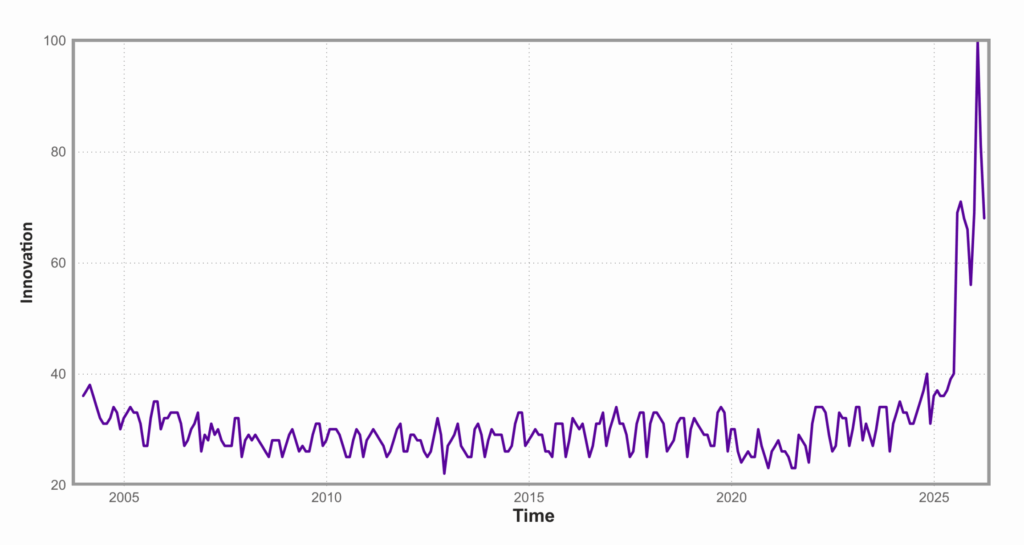
Stable ideas do not spike. They fade into the background, quietly agreed upon. When a concept becomes erratic—searched, debated, pulled in different directions—it is usually because its meaning is no longer clear. Not because everyone agrees on it, but because no one quite does.
For years, innovation was not a debate, it was doctrine. It sat at the centre of corporate identity, repeated often enough to feel like strategy: innovation strategies, innovation labs, innovation theatre. Entire organisations arranged themselves around the idea that the future belonged to those who could launch, announce, and demonstrate something new. The more visible the effort, the stronger the signal and so visibility became the metric.
It is not difficult to see how we arrived here. Innovation is easy to applaud. It produces artefacts—prototypes, pilots, press releases—that look like progress. It gives boards something to point to and leaders something to present. It creates the reassuring sense that movement is happening, even when very little has actually changed.
What it rarely does, on its own, is deliver. Scratch beneath the surface and the pattern is familiar. AI pilots that stall before scale. Transformation programmes that never quite transform. Promising ideas that collide with procurement rules, legacy systems, and decision processes designed for a slower world. Innovation appears at the edges, bright and energetic, only to be absorbed and neutralised by the core.
A failure of integration
This is not a failure of imagination. It is a failure of integration. Kodak is often held up as a cautionary tale of missed innovation. It is, in fact, the opposite. Kodak engineer Steve Sasson invented the digital camera as early as 1975. The problem was not a lack of ideas. It was an inability—or unwillingness—to rewire the business around them. The technology existed, the system did not, and it is now being exposed.
The recent surge in attention around innovation is not a sign of confidence. It is a sign of discomfort. Organisations are not simply searching for innovation—they are trying to work out what it is supposed to mean in a world where novelty no longer guarantees advantage because the environment has changed. AI is compressing timelines. Geopolitics is complicating supply chains. Economic pressure is forcing choices that favour resilience over experimentation. Under these conditions, the question is no longer “what can we launch?” but “what actually holds?” That question leads to less glamorous territory.
Increasingly, the real work of reinvention is happening away from the stage. In supply chains that are being rebuilt for reliability rather than efficiency. In decision systems that prioritise speed over hierarchy. In operational processes that are finally being redesigned to support, rather than resist, change. It is painstaking work, largely invisible, and profoundly unexciting to anyone looking for a headline but it is where advantage is now being built.
Recent signals, including operational insight from McKinsey & Company and Deloitte, point in the same direction. The biggest gains are not coming from the next idea. They are coming from making existing ones work. From fixing the infrastructure that innovation was supposed to sit on but rarely did.
Boards are catching on, albeit quietly. The conversation is shifting from possibility to proof. Fewer questions about what is being piloted. More questions about what is delivering. Less tolerance for experimentation that never leaves the lab. More pressure to demonstrate that something—anything—has actually changed.
Deliver when it matters
This is not the end of innovation. But it may well be the end of how we have practised it because the uncomfortable truth is this: innovation, as it has been pursued, has been too easy to perform and too difficult to operationalise. It has allowed organisations to signal progress without fully committing to the hard, structural work required to achieve it. That gap is now where the real competition sits.
The companies that will define the next phase are unlikely to be the ones with the most ambitious pilots or the most compelling narratives. They will be the ones that treat operations as strategy, not afterthought. The ones that invest less in what can be announced and more in what can be sustained. The ones that understand that reinvention is not a moment of creativity, but a system of execution. In other words, the companies that win now will not be the most innovative. They will be the most operationally intelligent.
The spike in attention suggests that something is shifting. Not a renewed belief in innovation, but a growing recognition of its limits as it has been practised. The language remains the same, but the expectations behind it are changing. And that is usually how doctrine ends—not with a rejection, but with a quiet loss of faith.
The future will not belong to those who perform innovation most convincingly. It will belong to those who move beyond the theatre, fix what they once ignored, and build organisations that can deliver when it matters.
Photo: Dreamstime.