
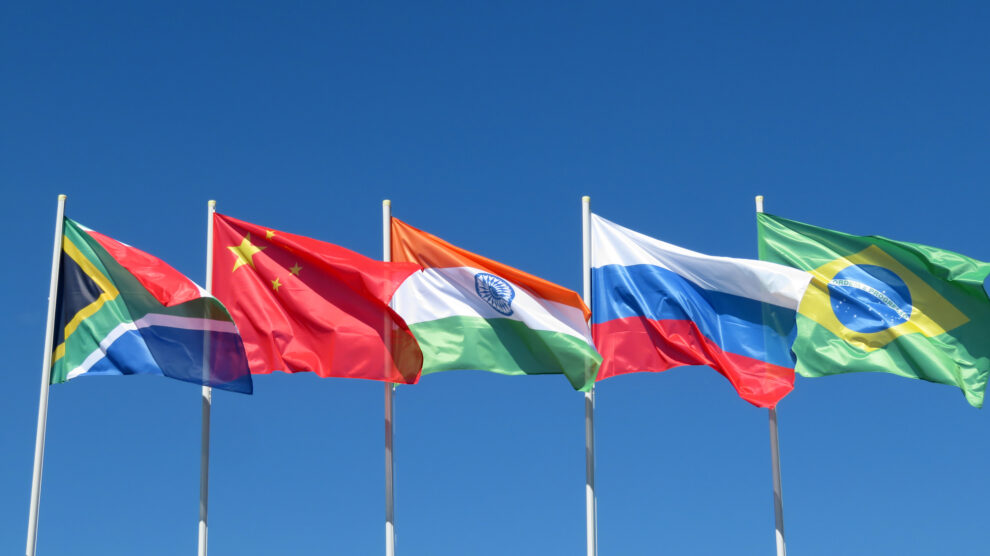
Some ‘sovereigntists’ in the EU dream of an alternative to Brussels, but even Russia admits that BRICS cannot yet provide what they want.
Aleksandar Vulin, Serbia’s then deputy prime minister, told TASS in October 2024 that citizens would have to choose, within two or three years, between the European Union and BRICS in a referendum. His boss, President Aleksandar Vučić, had said days earlier that BRICS’ approval rating in Serbia had reached 42 per cent, on a par with the EU’s. Ordinary Serbs, he told RTS, sensed BRICS was “made up of countries that blackmail us less.” Neither man had yet decided whether Serbia should apply for full membership or settle for the newer, vaguer status of partner country.
BRICS held its first summit in Yekaterinburg in 2009, four years before South Africa joined and gave the acronym its final letter. Sixteen years on, the bloc still has no charter, no secretariat and no binding voting rules; decisions require consensus among members whose interests routinely diverge. At the 12th Primakov Readings in Moscow on June 24 2026, Sergei Lavrov, Russia’s foreign minister, told delegates that the group had suspended its own expansion plans, pointing to unresolved “divergences” among the ten full members it already has. Mr Lavrov was not a Western critic reciting a familiar complaint. He was one of the two founding powers that had pushed hardest for BRICS to grow, conceding in public that the growth had stalled.
Cyril Ramaphosa, South Africa’s president, has described his country’s refusal to condemn Russia’s invasion of Ukraine as pursuing “an independent foreign policy”. India has spent the past two years hedging against Chinese dominance of the same bloc, courting Washington even as it deepens ties with Moscow. Brazil, India and South Africa favour a loose, non-aligned reading of BRICS. China and Russia have pushed instead to turn it into an explicitly anti-Western pole. Serbia would be joining a club whose founding members cannot agree on what the club is for.
Luiz Inácio Lula da Silva, Brazil’s president, spent much of 2024 as the most vocal advocate of a common BRICS currency, floating it repeatedly during Brazil’s presidency of the bloc that year. After Donald Trump threatened, in December 2024, tariffs of up to 100 per cent on any country backing a dollar rival, the idea vanished from Brazil’s own agenda within weeks. Vladimir Putin, who had displayed a prototype BRICS banknote at the 2024 Kazan summit, told reporters that same month that Russia was not, in fact, seeking to abandon the dollar at all. The bloc’s declaration from its July 2025 summit in Rio de Janeiro, hosted by Lula himself, did not mention a shared currency once.
An expensive form of hedging
The New Development Bank (NDB), the bloc’s one functioning institution, had approved 42.9 billion US dollars across 139 projects by April 2026. BRICS Pay, the payments platform meant to bypass the dollar, is still described by its own architects as a pilot rather than a working system. Cheaper trade financing matters to businesses in Belgrade or Skopje as much as anywhere else. It is a smaller prize than the sovereignty-restoring alternative to Brussels that Vučić has floated to voters, and it does nothing to shield a small, EU-adjacent economy from the consequences of picking a side.
Since February 2022 no BRICS summit declaration has condemned Russia’s invasion of Ukraine. The bloc has instead shielded Moscow from diplomatic isolation, admitting Iran as a full member in 2024 and granting partner status to Belarus the same year. Serbia is still, at least on paper, pursuing EU accession. Full BRICS membership alongside Belarus and Iran would sit awkwardly next to that ambition, whatever savings on trade financing Vučić might point to.
None of which appears to have troubled Vulin much. Asked in the same TASS interview whether Serbia had settled on full membership or partner status, he said it had not, and that two to three years would be needed before BRICS became, in his words, “a much more coordinated organisation with appropriate institutions and political mechanisms”. We are approaching that deadline. Vulin is no longer in post. The institutions and mechanisms he spoke of have not materialised. On the evidence of Lavrov’s own admission in Moscow last month, they are not likely to do so any time soon.
Photo: Dreasmtime.