
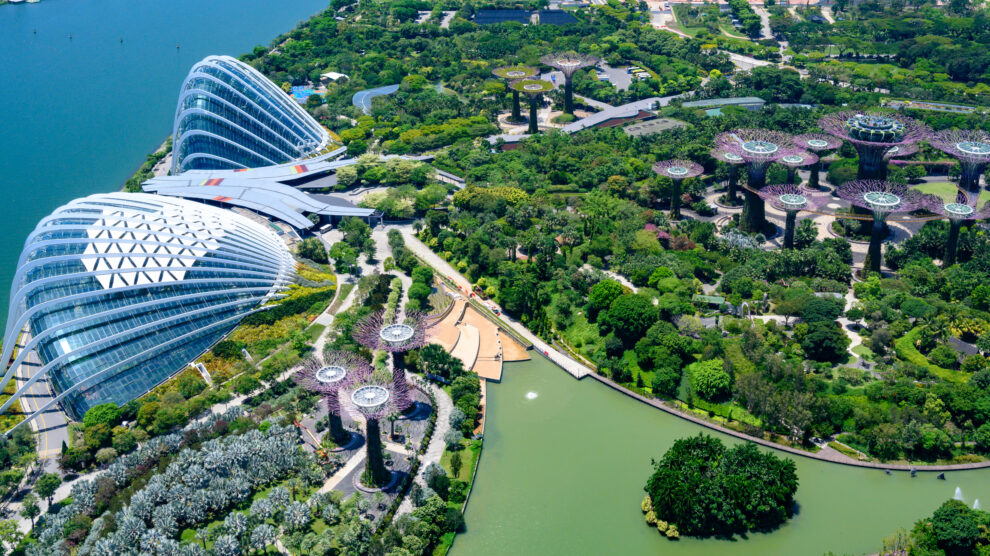
Reform politicians often cite Singapore as a low-tax, small-state model. Many of the city-state’s policies would suit a Green much better.
Conservative politicians in Western Europe rarely miss an opportunity to invoke the small Southeast Asian city-state of Singapore as a paragon of good governance. Richard Tice, deputy leader of the UK’s right-wing Reform party, was at it earlier this month, pointing out (in response to local councils in England, during one of the country’s worst ever droughts, asking householders not to water their gardens) that Singapore hasn’t rationed water since 1964. Leaving aside the fact that Singapore is one of the wettest places on Earth (even during the driest month, February, heavy downpours are common late in the afternoon), the right’s obsession with Singapore is misguided, even strange, to say the least. Conservatives admire Singapore’s strict immigration controls, its tough anti-crime and public disorder laws, its perceived free market economy, and generally view the city-state as proof that a society functions better with a strict moral code. What they usually fail to mention (either out of ignorance or wilful negligence) is that this code often restricts personal freedom, or that Singapore’s government plays an active role in the economy and owns a great deal of it (such as Singapore Airlines and Singtel, Asia’s leading communications and technology group). A free-market free-for-all (the kind of economy the European right dreams of) Singapore is not.
Take something as simple (in most societies, at least) as owning a car. The number of cars in Singapore is capped at around one for every ten people. Drivers need a special permit (which has to be purchased from the state) to own one. This month, prices for the permits (for an ordinary car) were 128,501 Singaporean dollars per piece, around 86,674 euros. That’s just for the right to own and operate a car, and does not include the car itself. The cost of vehicle ownership is therefore the highest in the world. Of course, there’s a trade off, which is that there are few (if any) traffic jams, while public transport is cheap and arguably without equal anywhere in the world. All well and good, but it’s a policy far more attractive to European Greens than its free-market right.
Much the same goes for housing, almost all of which is leased to residents by the state, and which gets handed out according to racial quotas, income levels, and marital status. The UK’s Reform might like the final part of that (Reform suggested this week that it would prioritise married couples over single parents in the allocation of social housing), but it is no doubt less keen on Singapore’s racial quotas (essentially, there are limits on how many Chinese, Malays, or Indians can live in any cluster of blocks owned by the Housing Development Board, or HDB). Around 80 per cent of Singaporeans live in HDB blocks.
The provision of health care in Singapore follows roughly the same model. Singapore offers its citizens a universal system, with the government picking up as much as 80 per cent of the bill in the public clinics and hospitals most people use. It pays for a good amount of this by obliging its people to save. Together, workers under the age of 55 and their employers give up 37 per cent of wages to the Central Provident Fund (CPF), a state-run savings scheme that also pays for housing and pensions. Part of every monthly salary payment is put into a compulsory medical account, known as MediSave, on top of which sits a national insurance scheme, MediShield Life, that no citizen is permitted to leave. ‘Forced savings’ and ‘government care from cradle to grave’ are not phrases a Reform politician likes to utter.
Singapore is also highly serious about tackling climate change. It aims to achieve net-zero carbon emissions by 2050 while adapting its urban infrastructure for rising sea levels and higher temperatures, it imposes a progressive carbon tax on large emitters to drive industrial energy efficiency, is big on recycling and the circular economy, and is genuinely committed to truly sustainable development. All the kinds of things that are anathema to Reform and the rest of the European right.
Dirigisme par excellence
Perhaps the biggest giveaway of Singapore’s less than free-market credentials however is the simple matter of who owns it. Temasek, the government’s investment fund, holds a portfolio worth more than 500 billion US dollars which includes stakes in the country’s largest firms (not just Singapore Airlines and Singtel but also DBS, the largest bank, the ports group PSA, the electricity grid, and the trains). A second fund, GIC, invests its reserves abroad. Together the two funds provide Singapore around one-fifth of the government’s annual budget, and Temasek’s local holdings make up roughly a third of the city-state’s entire stock market. The commanding heights of the economy do not belong to the market. They belong, more or less, to the state. It’s all very dirigiste.
To be fair to Reform and the rest of the European right, there is plenty about Singapore they understandably like. Singapore’s taxes are low, with the highest rate of personal income tax capped at 24 per cent, while companies pay a flat 17 per cent on profits. There is no tax at all on capital gains or inheritance. Even here, however, what often gets missed is that these low rates are affordable because the state earns so much money elsewhere, from the land it owns, the companies it controls, the investment it makes, and those obligatory savings.
All of which makes the regularly recurring dream of a ‘Singapore-on-the-Thames’, first floated by Philip Hammond when he was chancellor in 2017 and oft-repeated by free-marketeers ever since, so peculiar. To become Singapore, Britain would have to nationalise its airline, its railways, and its telecoms, cap the number of cars on its roads, house four of every five of its people in state-built flats, and dock more than a third of every wage for a state-run savings scheme. Jeremy Hunt, then foreign secretary, once likened Singapore’s 1965 split from Malaysia to Brexit. He should probably have looked a little bit closer at what the city-state did next.
None of which is meant to belittle Singapore or its achievements. It is an enormously well run country that offers the vast majority of its citizens a high standard of living. It’s just that its success has been brought about by policies that are a great deal more progressive than its conservative fans in Europe might wish to believe.
Photo: Dreamstime.